


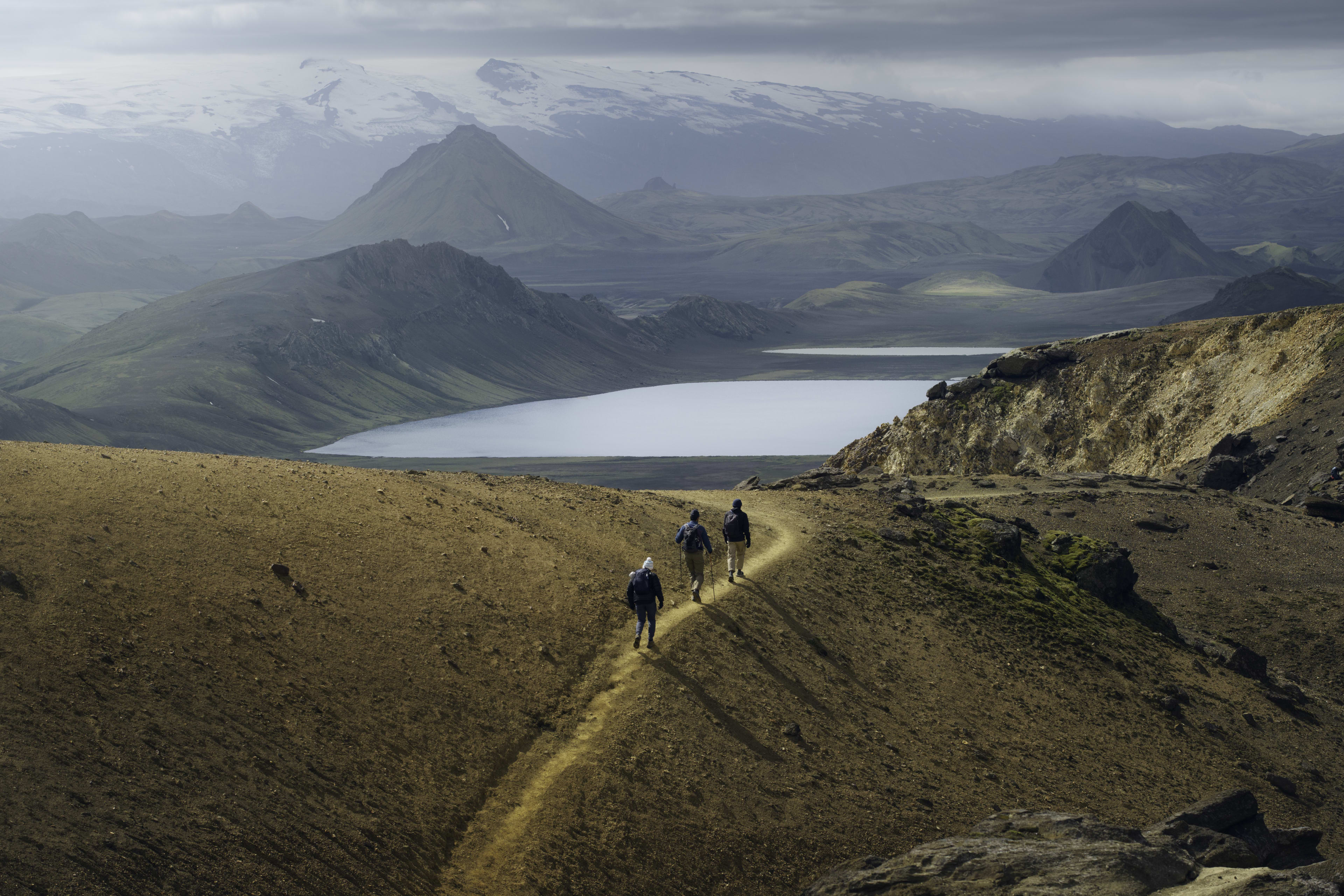
A Distinctive Green Landmark
Stórasúla stands as one of the most recognizable features along Iceland's famous Laugavegur Trail, its distinctive cone shape and verdant slopes providing a welcome contrast to the stark volcanic landscapes that surround it. Rising to 693 meters (2,274 feet) above sea level, this ancient volcano has become covered with lush vegetation over the centuries, earning it descriptive names like "the green conic volcano" among hikers who pass by its base.
The mountain's unique appearance makes it an omnipresent landmark for those hiking from Landmannalaugar to Þórsmörk. Unlike the black lava fields and barren volcanic terrain that dominate much of the highland landscape, Stórasúla's grass-covered slopes create a small oasis of green that stands out dramatically against the dark volcanic plains. This contrast showcases the remarkable diversity of Iceland's volcanic landscapes and the power of vegetation to transform even harsh volcanic terrain over time.
Location Along the Laugavegur Trail
Stórasúla sits at a crucial point along the Laugavegur Trail, marking the transition between the geothermal wonders and high altitude terrain of the northern sections and the increasingly varied landscape leading south toward Þórsmörk. The Hvanngil mountain hut, a popular overnight stop on the trail, nestles at the foot of Stórasúla's northern slopes, providing hikers with shelter and spectacular views of the green cone rising above them.
The volcano sits south of Brattháls, another distinctive hill in the region, and east of Stóra-Grænafjall, whose name translates to "Great Green Mountain." To the north lies the isolated peak of Stórkonufell. This positioning places Stórasúla at the heart of a landscape defined by volcanic features, each telling part of the story of Iceland's geological evolution.
Hikers typically encounter Stórasúla on their third day on the Laugavegur Trail, having descended from the exposed heights of Hrafntinnusker and spent a night near Álftavatn Lake. The approach to the volcano marks a shift in the trail's character, as hikers leave behind the green valleys around Álftavatn and prepare to enter the black sand deserts of Mælifellssandur that lie beyond.
An Ancient Volcano Transformed
While Stórasúla's exact age remains uncertain, its rounded shape and complete vegetation cover suggest it is an ancient volcanic feature that has been inactive for thousands of years. The cone's perfect symmetry indicates it likely formed during a single eruptive period, building up layer by layer as lava and volcanic material accumulated around a central vent. Over the millennia since its last eruption, weathering and erosion have smoothed its slopes while volcanic soil created by the breakdown of the original rock has provided a fertile base for plant life.
The green vegetation covering Stórasúla demonstrates the volcanic soil's richness and the resilience of Iceland's flora. Grasses, mosses, and hardy highland plants have colonized the slopes, creating a complete cover that transforms what was once a bare volcanic cone into a verdant landmark. This transformation occurs slowly in Iceland's harsh climate, making Stórasúla's green appearance a testament to the passage of significant geological time.
The volcano's position in the highlands means it endures harsh weather conditions, including strong winds, heavy precipitation, and extreme temperature variations. Yet the vegetation persists, creating a microclimate on the mountain's slopes where moisture and shelter support a surprising diversity of plant life compared to the surrounding barren terrain.
A Visual Marker in the Highlands
For Laugavegur Trail hikers, Stórasúla serves as more than just a geological curiosity. The volcano functions as an important visual reference point, helping orient hikers as they navigate through the highlands. The mountain's distinctive shape and color make it easily recognizable from various points along the trail, and its position marks the beginning of the trail section leading through the black sand deserts toward Emstrur.
The contrast between Stórasúla's green slopes and the black volcanic sands of Mælifellssandur, which begin just south of the volcano, creates one of the Laugavegur Trail's most dramatic landscape transitions. Within the span of a few kilometers, hikers move from verdant hillsides to a lunar-like desert landscape, passing through an environment that seems almost alien in its starkness. This rapid change in scenery exemplifies the geological diversity that makes the Laugavegur Trail so remarkable.
Photographers particularly appreciate Stórasúla for the visual contrast it provides. The green cone rising from dark volcanic plains, often with glaciers visible in the distance, creates compelling compositions that capture the essence of Iceland's highland beauty. On clear days, the mountain's slopes glow brilliantly green against blue skies, while in typical Icelandic weather, mist and clouds can shroud the peak, adding an element of mystery to its appearance.
Experiencing Stórasúla
Most hikers experience Stórasúla as part of their Laugavegur Trail journey, either staying at the Hvanngil hut at its base or passing by during the day's hike from Álftavatn to Emstrur. The trail does not climb Stórasúla itself but rather skirts along its foot, allowing hikers to appreciate the volcano's form and the shelter it provides from the prevailing winds.
The area around Stórasúla offers opportunities for short exploratory hikes for those with extra time and energy. The volcano's slopes, while steep in places, are not technically difficult to climb, and ascending partway up the cone provides expanded views of the surrounding highlands. However, most hikers choose to conserve their energy for the longer trail sections ahead and content themselves with viewing the mountain from the trail.
The Hvanngil area at Stórasúla's base provides a welcome respite for tired hikers. After the challenging descent from Hrafntinnusker and the traverse past Álftavatn, the sheltered position near the volcano offers protection from wind and a chance to rest before tackling the black sand deserts and river crossings that lie ahead. The mountain's presence creates a sense of place and permanence in the otherwise stark highland environment.
