


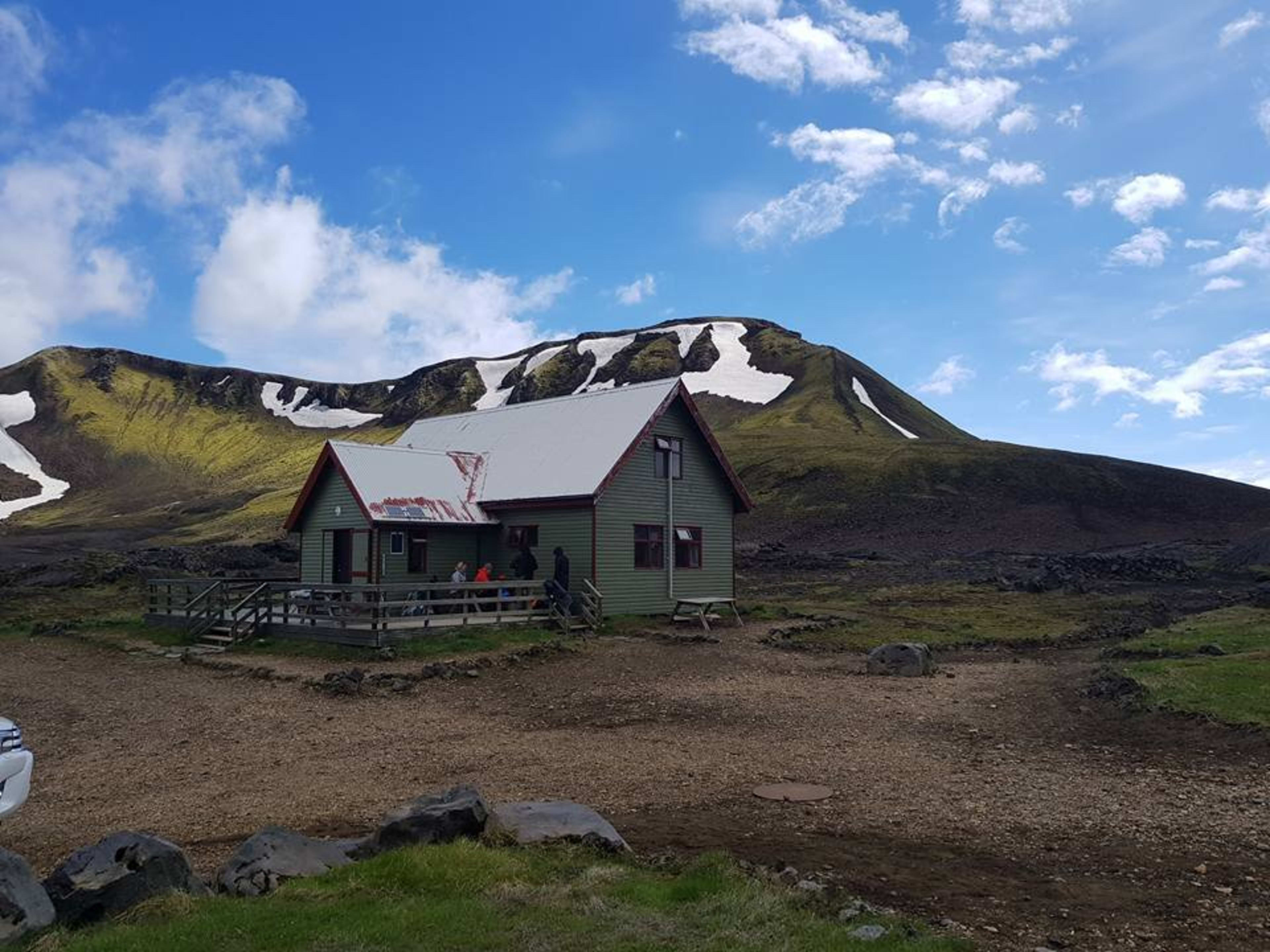

A Protected Refuge in the Highlands
Hvanngil, whose name translates to "angel gully" or "grass gully," provides a sheltered haven for hikers traversing Iceland's demanding Laugavegur Trail. This small valley nestles between moss-covered hills and volcanic ridges in the southern highlands, offering protection from the strong winds that frequently sweep across the exposed highland plateau. The valley's position at the base of the distinctive green cone of Stórasúla volcano creates a microclimate where vegetation thrives more abundantly than in the surrounding terrain.
The valley sits approximately 5 kilometers south of Álftavatn Lake, making it one of the lesser-visited stops along the Laugavegur Trail. Most hikers choose to spend their second night at the larger Álftavatn facility, which means Hvanngil often has better availability for those seeking a quieter, more intimate mountain hut experience. This relative lack of crowds adds to the valley's appeal for hikers who appreciate a more peaceful highland experience.
Mountain Huts and Historic Shelters
Hvanngil is home to two mountain huts that serve hikers on the Laugavegur Trail. The older structure, built in 1963, originally provided shelter for shepherds tending their flocks in this remote region during the summer grazing season. This building connects Hvanngil to Iceland's agricultural past, when farmers would bring their sheep to the highlands for summer pasture, a practice that continued for centuries in the harsh but fertile volcanic landscape.
The second hut, constructed in 1995 by the Icelandic Touring Association, was purpose-built for hikers and can accommodate up to 60 people. The facility offers basic but adequate amenities including dormitory-style sleeping quarters, a communal kitchen equipped with gas stoves and cooking utensils, cold running water, and shower facilities. The huts connect to separate bathroom buildings via a patio that wraps around the structures, providing sheltered access even in poor weather.
Near the huts stands evidence of even older human activity in the area. An ancient sheep enclosure, now partially in ruins, marks this location as a historically significant gathering point for shepherds. These stone walls, built generations ago, testify to the endurance required to work in Iceland's highlands and the importance of locations like Hvanngil that offer some protection from the elements.
A Valley of Contrasts
The landscape around Hvanngil showcases the dramatic contrasts that define the Laugavegur Trail. The valley itself contains patches of lush grass and wildflowers, nourished by the shelter from wind and the presence of a small river that flows through the area. This green oasis stands in stark contrast to the black sand plains and hardened lava formations that surround it on multiple sides.
Looking north from Hvanngil, hikers can see back toward Álftavatn and the route they descended from Hrafntinnusker. To the west rises Stórasúla, its green slopes providing a dramatic backdrop to the valley. South and east, the terrain becomes increasingly barren, transitioning into the black volcanic deserts of Mælifellssandur that stretch toward Emstrur.
The valley marks an important transition point on the trail. Hikers arriving at Hvanngil have left behind the high plateau with its geothermal features and snow fields. Ahead lies different terrain characterized by volcanic sand, increased river crossings, and the gradual approach to the glaciated peaks of Mýrdalsjökull and Eyjafjallajökull that dominate the southern horizon.
Camping in an Old Lava Field
The campsite at Hvanngil offers two distinct areas for pitching tents. The first sits within an old lava field near the huts, where the irregular volcanic rock provides excellent natural windbreaks. Hikers camping here benefit from significant protection from the wind, though they must navigate the uneven terrain when setting up their tents. The lava field's black rock retains heat during sunny periods, creating slightly warmer conditions than might be found on open ground.
The second camping area occupies a grassy section approximately 200 meters from the main huts. This location offers a more traditional camping experience on softer ground, though with less protection from wind. Both camping areas provide access to the hut's bathroom facilities, an important amenity given the harsh highland conditions.
The choice between these camping options reflects the adaptability required for successful highland hiking. Experienced hikers assess wind direction, weather forecasts, and personal preferences when selecting their spot, knowing that conditions can change rapidly in this exposed environment.
River Crossings and Trail Connections
The trail through Hvanngil involves several water crossings that vary in difficulty depending on recent rainfall and snowmelt conditions. Hikers approaching from Álftavatn must wade the Bratthálskvísl river, typically a modest crossing but one that requires proper technique and water shoes. This crossing serves as preparation for the more challenging fords that lie ahead on the trail.
Leaving Hvanngil, hikers cross the Kaldaklofskvísl river via a footbridge, one of the few bridged crossings on the Laugavegur Trail. Beyond this point, the trail splits, with one branch leading south toward Emstrur and Þórsmörk, and another heading east toward Mælifellssandur and the F210 mountain road. Most hikers continue south, soon encountering the Bláfjallakvísl river, which must be waded and represents one of the larger river crossings on the trail.
These river crossings demand respect and proper preparation. Water levels can rise quickly during heavy rain or warm periods that increase glacial melt. Hikers must be prepared with appropriate footwear, hiking poles for stability, and the knowledge that cold water immersion is part of the highland hiking experience.
Visiting Hvanngil
Access to Hvanngil is exclusively via the Laugavegur Trail, as the valley sits far from any roads in the uninhabited highlands. Most hikers reach Hvanngil on their second or third day on the trail, depending on their chosen itinerary and overnight stops. The valley serves as either a lunch break for those hiking from Álftavatn to Emstrur in a single day, or as an overnight stop for those preferring shorter daily distances.
The hiking season runs from late June through early September, when the huts are staffed and trails are most accessible. Even during this period, hikers should prepare for challenging weather including rain, wind, cold temperatures, and even snow. The shelter provided by Hvanngil's valley walls and buildings makes it a particularly valuable stop during poor conditions.
Booking accommodation at Hvanngil typically proves easier than at other Laugavegur huts, as its proximity to Álftavatn means many hikers skip this stop. This makes Hvanngil an excellent option for those planning their trek late in the season when other huts may be fully booked.

